the Nuclear Renaissance
Critical
Path
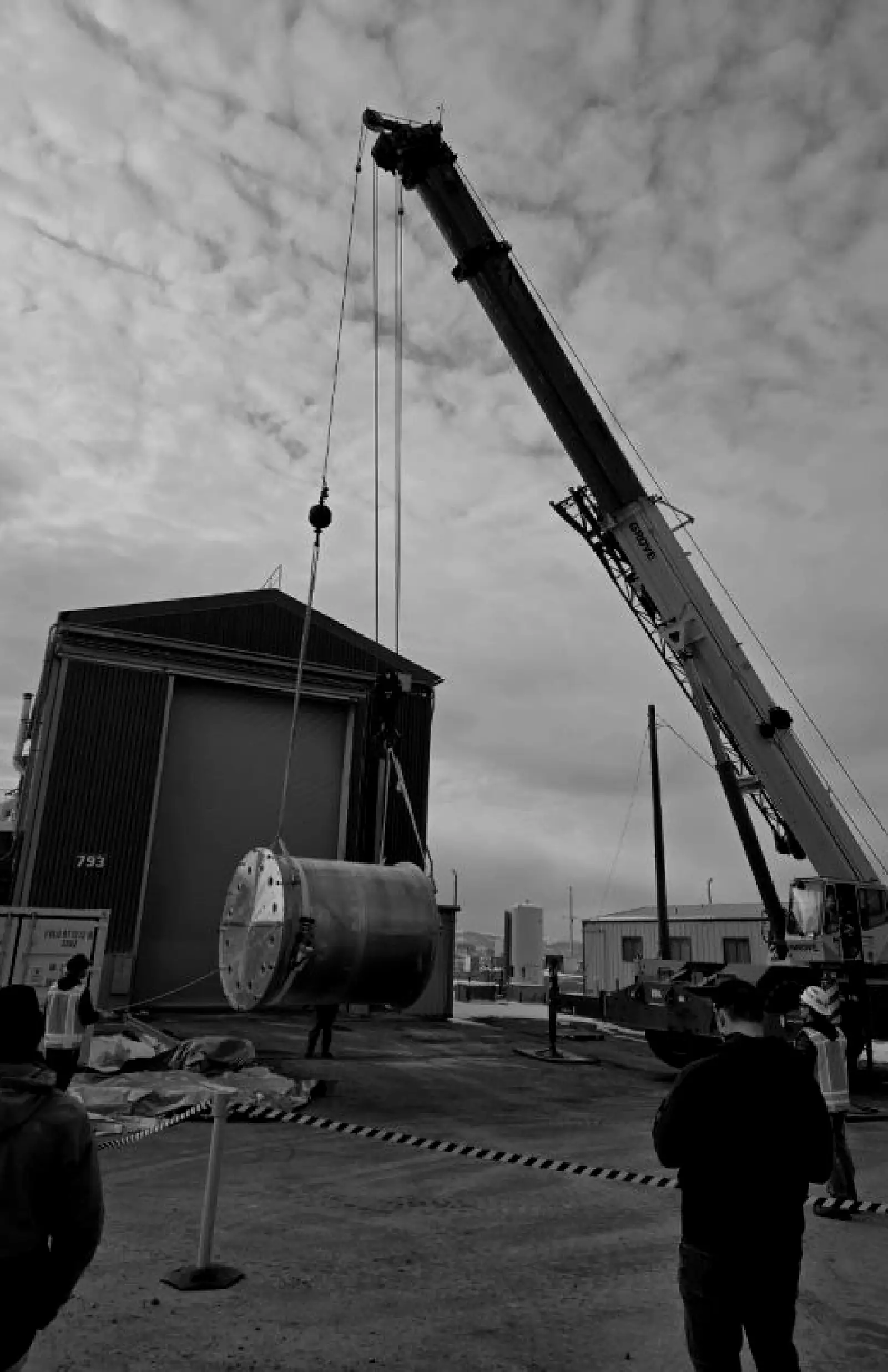
06.04.2026 · The core arrives at Building 793. Mark-0 sustains its first chain reaction on schedule. Inside: the report, the fuel, the history, the machine.
Status line: Mark-0 achieved criticality June 4, 2026. Mark-1 electricity production targeted 2027. First defense deployments targeted 2028.
Critical Path
Index · 001
In this issue.
In program management, the critical path is the sequence of work that sets the schedule: slip it and everything slips. In a reactor, criticality is the moment the machine comes alive. This zine lives where those two meanings meet. Made for the people who buy power the way they buy propulsion, in the spirit of the shop floor: brief, direct, and on schedule.
- 03Achieve CriticalityThe Mark-0 report from Idaho. Six months from install to a sustained chain reaction.
- 05Nuclear 101Fission without the fog, and the fuel that shrugs at 1,600 degrees.
- 07The Fuel CycleSeven states of one kilogram, from ore to core to the long quiet after.
- 08The Renaissance Is HiringPull-out poster. Copywriters and technical writers, report to the factory floor.
- 10The American Atom1942 to 2026. How we led, how we stalled, and how the turn came.
- 13The Machine · The MapR1 spec sheet, the sites that carry the program, and the atlas online.
Mission: abundant energy from Earth to the asteroid belt. Factory-produced, deployable fission microreactors for mission-critical systems across Earth, space, and underseas.
Report · No. 001 · Building MFC-793
Report · No. 001
Page 03
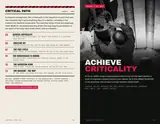
Achieve
Criticality
At 3 a.m. shifts inside a repurposed sodium shop on the Idaho desert, a crew of engineers walked a brand new reactor up to the oldest threshold in the business: the moment a chain reaction feeds itself.
Criticality is not an explosion and it is not a light switch. It is a balance point. Load enough fuel in the right geometry, manage the neutrons carefully, and the reaction that splits one atom releases the neutrons that split the next. When exactly one generation of neutrons produces the next, the reactor is critical. It is the first proof that a paper design is a real machine.
On June 4, 2026, the Mark-0 microreactor crossed that threshold at Idaho National Laboratory, the first privately developed advanced reactor to reach criticality under the DOE's Reactor Pilot Program. It happened in Building MFC-793, a former sodium components shop, in a below-grade pit on the east side of the high bay.
Commissioning took under six months. In a field where schedules are measured in decades, that number is the story. Mark-0 is a zero-power unit: the chain reaction ran with essentially no thermal output, by design, to prove the physics, the control drums, and the safety case in hardware.
It is the first novel reactor design at INL in more than fifty years, and the fifty-third reactor on the desert since 1951.
"We said criticality in 2026, electricity production in 2027, and power to the warfighter in 2028."
The Schedule Is the Product
2026
Criticality
Done. First through the gate, June 4, on the eve of the nation's 250th year.
Complete
2027
Electricity
Mark-1 pairs the core with a nitrogen Brayton cycle and puts watts on wires. The full-power prototype lands at INL.
Targeted
2028
Deployment
Production units ship to defense installations, starting at Joint Base San Antonio.
Targeted
Partners: DOE · INL · BWXT · U.S. Army
Section 06 · The Map
06 Pins · 01 Beyond the Frame
Where the
work is.
A reactor company is a logistics company. Fuel is fabricated in Virginia, cores are machined in California, physics is proven in Idaho, and power lands on bases in Texas. The critical path runs through every one of these pins. If any site slips, the schedule slips, and the schedule is the product.
Domestic pins are projected with geoAlbersUsa. Capenhurst sits beyond the frame and is marked with a diamond.
Section 06 · The Machine
Spec Sheet · Production Unit
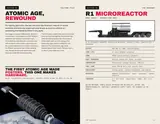
R1 Microreactor
Factory-built, trailer-integrated, road mobile. It arrives by road and connects like a generator.
| Output | 100 kWe to 1 MWe, load-following |
|---|---|
| Core life | 6+ years between refueling |
| Core | TRISO-fueled prismatic graphite |
| Heat transport | Passive sodium heat pipes, no pumps |
| Conversion | Recuperated nitrogen Brayton, <300 psi |
| Fuel load | Under 120 kg for a full service life |
| Deployment | Factory-built, trailer-integrated |
| Missions | Defense installations · space · underseas · remote industry |
| Partners | U.S. Air Force · Space Force · NASA · DIU · U.S. Army |
How the machine holds the balance
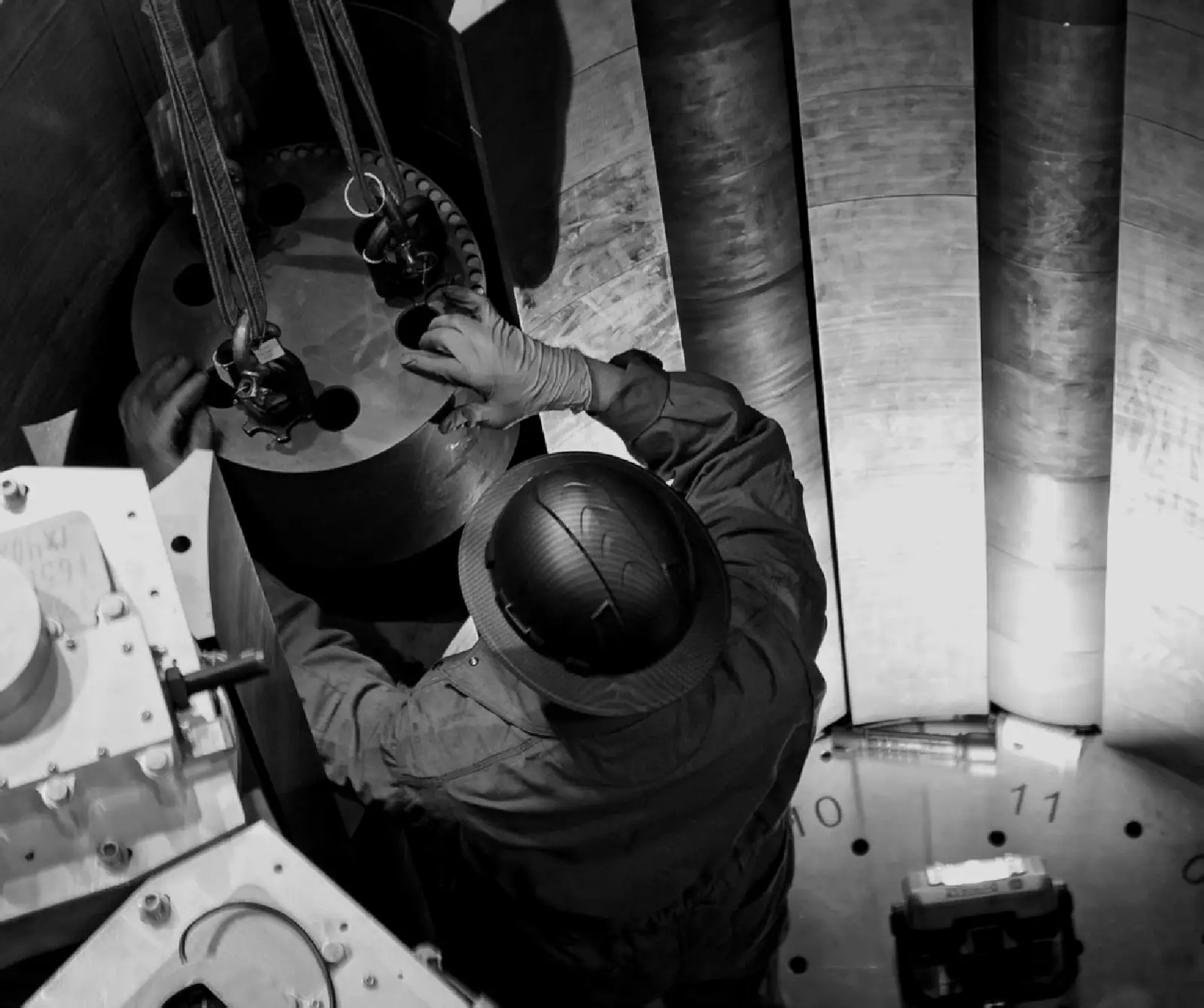
- The CoreMachined graphite drilled with channels. The graphite slows fast neutrons until they can split the next atom. Fuel compacts slot in like rounds into a magazine.
- Control DrumsCylinders around the core, absorber on one face, reflector on the other. Rotate one way and the reaction builds. Rotate back and it dies. Simple, mechanical, testable.
- Heat PipesSealed sodium heat pipes pull heat out passively. No pumps, no valves, no coolant loop to break. Physics does the plumbing.
- Power ConversionA recuperated nitrogen Brayton cycle under 300 psi spins a turbine. Modest pressures, common working fluid, hardware a maintainer can reason about.
Design doctrine: simple design optimized for reliability. One gram of U-235 ≈ the energy of about 3 tons of coal. No combustion, no smoke, no CO2 at the fence line.
Section 02 · Basics, No Fog
Page 05
The fuel that shrugs.
Every power plant on Earth is a machine for making heat and turning it into motion. Coal burns. Gas burns. A reactor does something better: it splits. Gram for gram, fission releases about a million times more energy than burning anything.
TRISO: the toughest fuel on Earth
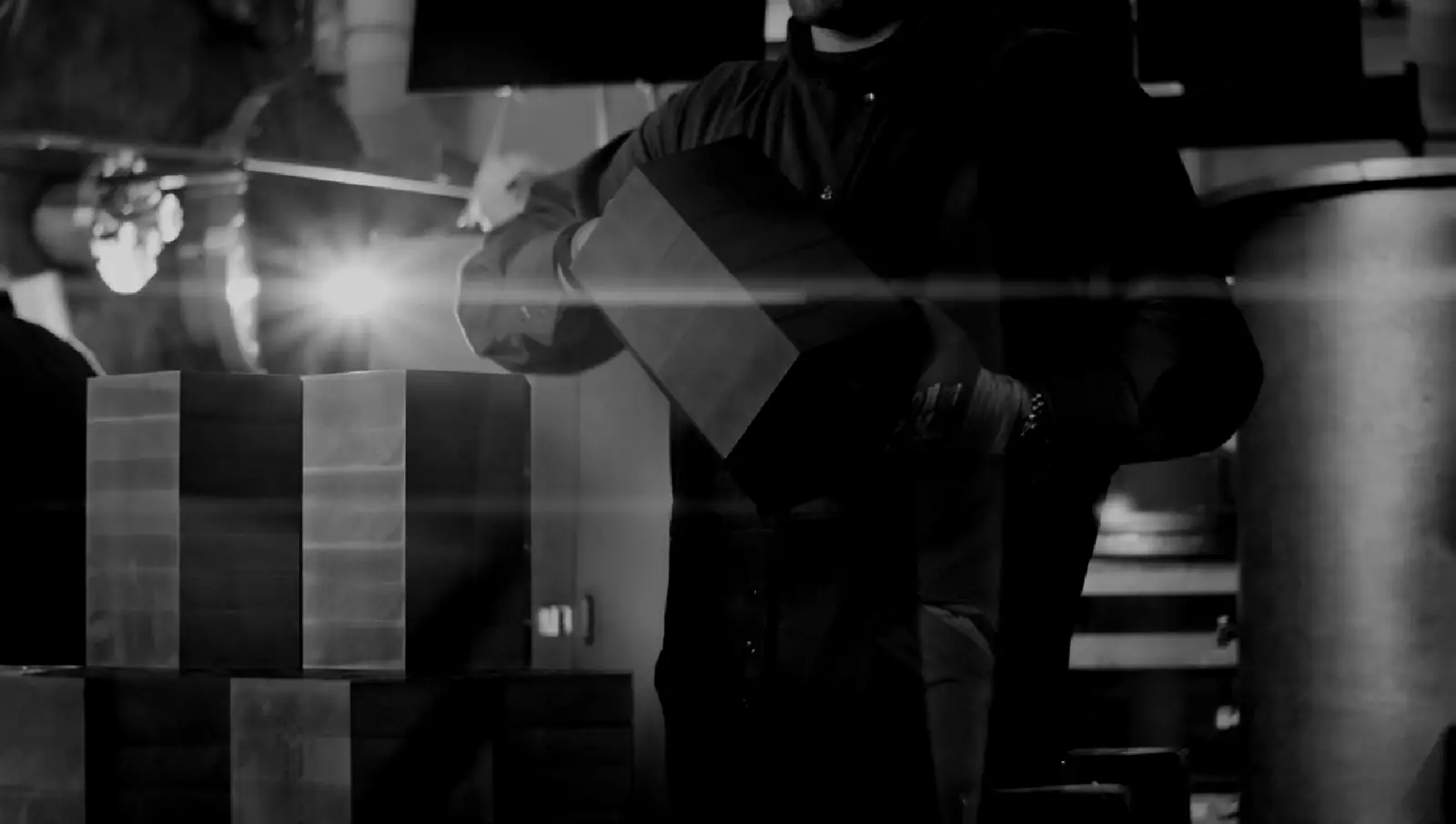
Each kernel of high-assay low-enriched uranium is smaller than a poppy seed, wrapped in three layers of carbon and silicon carbide. Every particle is its own pressure vessel and its own containment building. Pack thousands into a graphite compact and you have fuel that holds its fission products through temperatures far beyond anything the reactor can throw at it.
Mark-0 runs TRISO compacts fabricated by BWX Technologies in Lynchburg, Virginia, to the specification proven under the Army's Project Pele. Total load for its operating life: less than 120 kilograms. Future cores are covered by a multi-year HALEU supply agreement signed in May 2026.
- KernelHALEU oxycarbide, <20%
- LayersPorous carbon · PyC · SiC · PyC
- BehaviorHolds past 1,600°C
- FabricatorBWXT, Lynchburg VA
Section 03 · Ore to Core and After
Page 07
The fuel cycle.
Uranium's working life is a supply chain story. It crosses a continent, changes state four times, and ends its service quieter than it began. The renaissance runs on HALEU, uranium enriched to just under twenty percent, and rebuilding the American chain that makes it is one of the quiet races of the decade.
- MineOre comes out of the ground carrying a fraction of a percent of uranium.
- MillCrushing and chemistry concentrate it into yellowcake, packed in steel drums.
- ConvertThe oxide becomes uranium hexafluoride, a gas when warmed. Exactly what the next step needs.
- EnrichCentrifuge cascades raise the share of U-235. Reactor grade is 3 to 5 percent. HALEU pushes to just under 20: more energy in less core.
- FabricateEnriched uranium becomes TRISO kernels: coated, compacted, inspected particle by particle in Lynchburg, Virginia.
- OperateUnder 120 kilograms of fuel runs a microreactor for six or more years. No convoys, no pipeline, no resupply flights.
- RestSpent TRISO is its own containment. A service life of waste fits in the cradle it arrived in.
U.S. share of global enrichment, 1960s: about 90 percent. Today: under 1 percent. The gap is the mission.
Section 04 · 1942 → 2026
Page 10
The American
Atom
America invented this industry under a squash court in Chicago, lit the first lightbulbs with it on the Idaho desert, then spent forty years walking away from its own lead. The history is short, violent, and useful.
1942
CP-1 goes criticalFermi's team stacks graphite and uranium under the stands of Stagg Field and pulls the rod. The first self-sustaining chain reaction runs 28 minutes. The age begins with a slide rule and a cup of Chianti.1951
EBR-I lights the bulbsFirst electricity from fission: four 200-watt bulbs in a concrete room in Arco, Idaho. The desert around it grows into the site now called Idaho National Laboratory.1955
Nautilus gets underwayRickover's Navy puts a reactor in a hull. Compact reactors are born military.1957
Shippingport syncs to the gridFirst full-scale civilian plant, Pennsylvania. Atoms for Peace becomes kilowatt-hours.1973
Peak order bookUtilities order dozens of plants in a single year. America commands roughly 90 percent of the free world's enrichment capacity.
The Stall
Then the lead evaporated. Costs ballooned as designs churned mid-construction. Three Mile Island in 1979 froze public trust, and Chernobyl in 1986 buried it. Orders placed after 1973 were almost all cancelled. For thirty years the country that invented the reactor finished almost none, and the workforce, the supply chain, and the enrichment cascades wound down with it. By the 2010s the U.S. produced under one percent of the world's enriched uranium and imported the difference, much of it from strategic rivals.
The Turn
The comeback did not start with nostalgia. It started with load growth: AI compute, electrification, and a defense establishment relearning that energy is upstream of everything it does. Vogtle's new units proved big plants could still be finished. Executive orders in 2025 reopened the pipeline, and the DOE Reactor Pilot Program dared builders to put fuel in real cores fast. Mark-0 answered first. The next chapter of the American atom is not being written by committee. It is being machined, on schedule.
First novel reactor design at INL in 50+ years · Reactor No. 53 on the desert since 1951
The Reader · Vol. 001
16 Pages · 09 Spreads
Read the issue.
Sixteen pages, fit to the window. The reader takes the whole screen so a spread is actually readable: arrow keys, swipe, thumbnails, a page-at-a-time mode for narrow screens, and a link for every page.
Open the reader →

Jump straight in
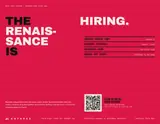
Pull-out Poster · Recruiting File 001
The Nuclear
Renaissance
Is Hiring.
Wanted: copywriters who can read a spec sheet. Technical writers who can make a neutron sing. Storytellers who think a factory floor at 3 a.m. is the most romantic place on Earth.
06Open roles
Los Angeles · Full time
As of July 2026
The open roles · Six ways in, one address
- Senior Turbomachinery Engineer
- Reactor Hardware
- Mission Engineer
- Mission Engineering
- Materials Engineer II
- Materials Engineering
- EHS Lead
- Manufacturing & Quality
- Senior Test Technician
- Test
- General Application, Engineers
- All Teams
No role that fits? The general application is the door. Live list, updated as roles open.
Strategic energy is national security. The atom is back on American time.
Dispatch · Program Updates
No More Than Monthly
Sign the manifest
Every gate, when it clears.
Criticality is logged. Electricity and deployment are next. Leave an address and the dispatch arrives when a gate moves, not before.
One address, program updates only. No forwarding to third parties. Unsubscribe in any dispatch.